
Here are additional resources to support your COPD management
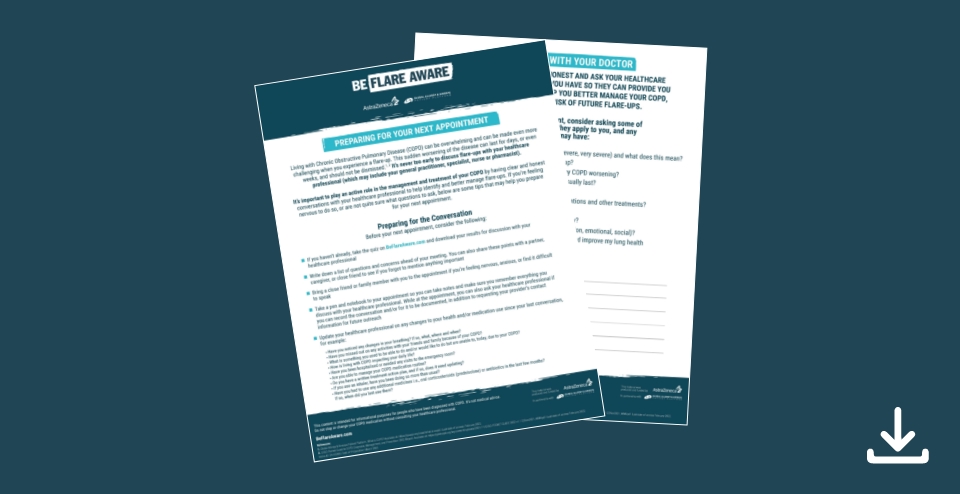

Download a guide to prepare you for your next healthcare appointment
Book a confidential telephone appointment with the
Lung Foundation Australia Respiratory Care Nurse Service

 Book your free appointment here
References:
- Lung Foundation Australia. Overview Chronic Obstructive Pulmonary Disease. Available at: https://lungfoundation.com.au/patients-carers/living-with-a-lung-disease/copd/overview/. Accessed July 2022.
- Hurst JR et al. N Engl J Med. 2010. 2010;363;1128-38.
- Lung Foundation Australia. COPD The Basics Booklet. Available at: https://lungfoundation.com.au/wp-content/uploads/2018/09/Book-COPD-The-Basics-Nov2021.pdf. Accessed July 2022.


CONTACT US
If you require assistance, please contact Medical Information at AstraZeneca Australia on
1800 805 342
Monday to Friday
(9am - 5pm AEST)
CONTACT US
If you require assistance, please contact Medical Information at AstraZeneca Australia on
1800 805 342
Monday to Friday
(9am - 5pm AEST)